
Pimp Culture Is Everywhere, and We Pretend Not to See It
Written by Cher Mollé
Co-Director of Development, Disruptors Org
(All thoughts and opinions are my own.)
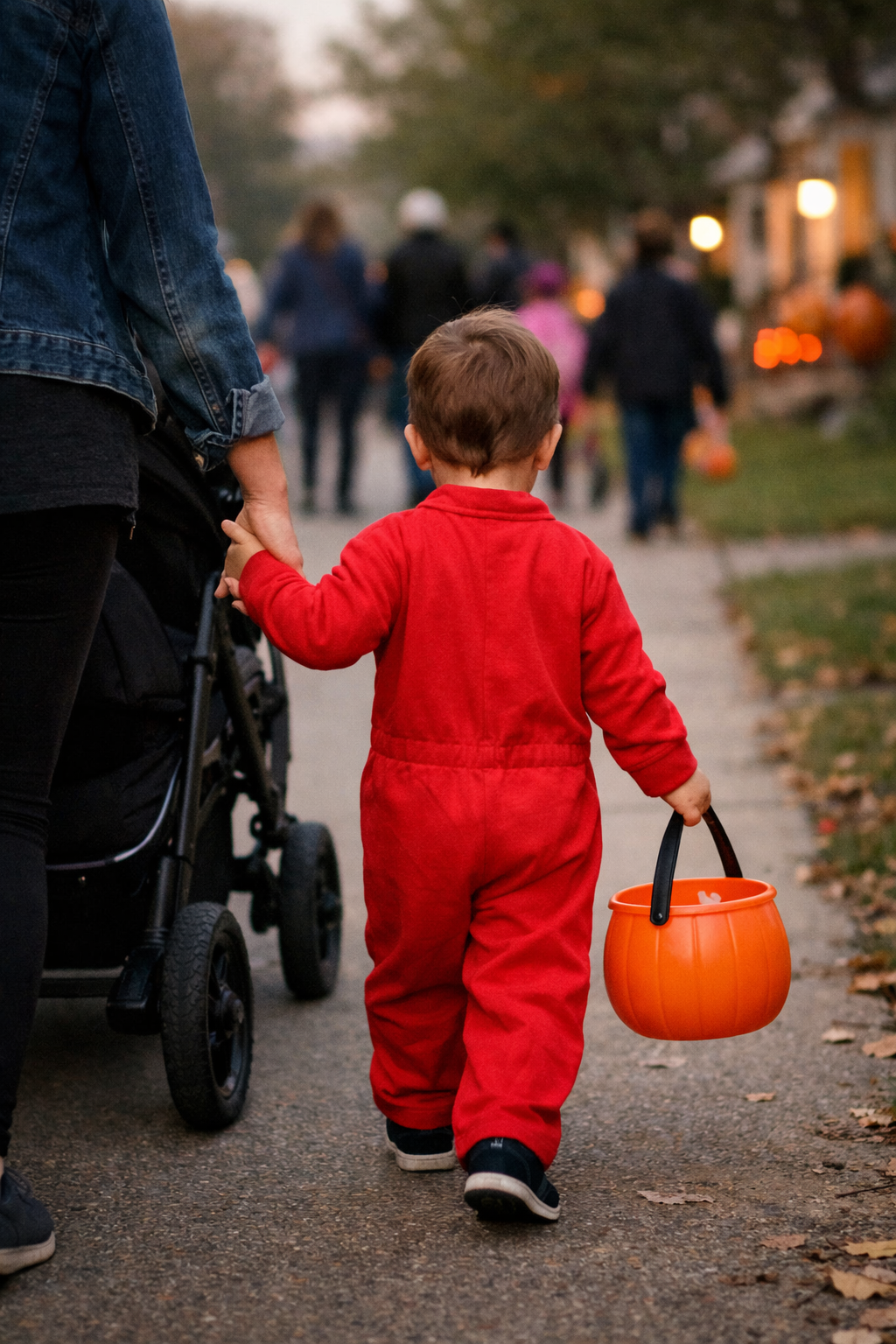
My son’s hand felt so small in mine. At three years old, he was dressed up as Spider-Man for Halloween just a few months ago. We were standing on a quiet suburban sidewalk in the United States, and the air was surprisingly warm for the season. Together, we were pushing a stroller with my six-month-old twins. We were trick-or-treating in what most people would describe as a “good” place to raise kids: a small East Coast suburb, strong schools, friendly neighbors, a sense of safety.
It should have been a normal, pleasant family night, but then something happened that I will never forget.
Just as we were walking away from a house, a teenage boy approached wearing a pimp costume.
The costume caught my eye and stopped me in my tracks. I turned back to look at other adults, and I am not sure what I was expecting, but what they did next shocked me.
They laughed.
“OMG, is that a pimp?” one of them chimed.
“That is so good,” said another.
“Golden,” and “Amazing,” followed.
I couldn’t get my son away fast enough. I wanted to say something, but my voice caught in my throat. And that silence has been sitting with me ever since… Because once you see it, you can’t unsee it.
And since that night, examples of sexual exploitation— or pimp culture—have appeared everywhere. Not hidden. Not fringe. Just… normal. So normalized, in fact, that adults can laugh at it in front of children without pausing to ask what, exactly, they’re celebrating.
The Culture We Live In Without Noticing
That Halloween moment cracked something open for me. I started noticing how often sexual exploitation shows up in our culture, not as harm, but as background. As entertainment. As something we’re expected to accept without comment.
Since Halloween, I finally watched Sons of Anarchy (and I realize how late I am in seeing this show). I thought it was a motorcycle show, a crime drama. What I didn’t expect was how deeply saturated it would be with sexual exploitation.
The “hero” of the series wants to go legit, not by leaving exploitation behind, but by running an escort service. In other words, by becoming a pimp. His mother is romantically involved with a pimp. Together, they run a brothel. The women—always referred to as “girls”—are disposable. Eventually, every single one of them is murdered.
The show, and so many others like it, are framed as gritty storytelling. Complex. Compelling. Violence against women as an atmosphere.
Scroll through any streaming service, and you’ll see versions of the same thing: sexual exploitation as set dressing; as shorthand for edginess; as entertainment.
The News Isn’t Much Better
We like to imagine a clean line between “fiction” and “real life.”
There isn’t.
The Epstein files revealed a trafficking operation that reached extraordinary levels of wealth and power; not a fringe anomaly, but a system enabled by institutions, silence, and active complicity.
Then there’s Sean “Diddy” Combs: a cultural figure whose influence shaped music, masculinity, and celebrity for decades, now named in allegations that echo the same themes we claim to be shocked by every time they surface. Control. Coercion. Sexual violence. Protection by powerful networks.
The Soundtrack of My Girlhood
I’m 35. Which means the music of my adolescence and early adulthood was steeped in pimp culture, even when we didn’t yet have that name for it.
In the rap genre, Jay-Z’s ‘Big Pimpin’ in 2000 wasn’t controversial; it was iconic. The song openly celebrates controlling women, profiting from them, and moving through their bodies without consequence. The video reinforces the message visually: women as interchangeable, hypersexualized props orbiting powerful men. Wealth, masculinity, and sexual dominance are fused so tightly that exploitation reads as success. This wasn’t fringe rap. This was mainstream culture.
In pop, in 2001, ‘Lady Marmalade’ exploded across MTV and radio, performed by Christina Aguilera, Lil' Kim, Mýa, and Pink. Framed as empowerment, the song is explicitly about sex work: flirtation, transaction, and access. The video glamorizes a brothel: corsets, cages, voyeurism, and spectacle. Sexual commodification isn’t interrogated; it’s aestheticized and sold back to girls as confidence and liberation. The lesson is subtle but clear: if you present exploitation with enough glamour, it becomes aspiration.
Also on pop radio in 2001, Britney Spears released ‘I’m a Slave 4 U.’ Britney was nineteen. The title alone matters. The song frames submission as desire; the video doubles down—sweat-soaked bodies, surveillance-like camera angles, adult men circling a teenage girl whose sexuality is being choreographed, branded, and consumed. This wasn’t about agency; it was about training a generation to confuse sexual availability with empowerment, and obedience with confidence. Pimp culture doesn’t always announce itself as control; sometimes it arrives as a hook you can dance to.
Rock radio carried its own version of the same worldview. Nickelback’s popular ‘Figured You Out’ single from 2003 framed women as disposable rewards: something to be used, conquered, and discarded once boredom sets in. No explicit pimps. No trafficking plotline. Just entitlement normalized and packaged for mass consumption. Boys learned contempt. Girls learned what to expect.
Different genres. Same era. The same lesson: women’s bodies are commodities, and men’s desire is entitlement.
We danced to it. We memorized it. We thought it was “just music,” but it wasn’t.
Culture Teaches, and Repetition Normalizes
The music and television (not to mention the films, video games, magazines, etc.) we consume both reflect and actively shape the culture we live in.
They’re symptoms of a culture that normalizes sexual exploitation, particularly the sexual exploitation of women and girls.
They’re proof that pimp culture is everywhere. It doesn’t just live on street corners. It lives in boardrooms, on private jets, in recording studios, and in gated communities. It survives because it’s profitable, and because we’ve been socialized not to question it.
Culture teaches, and repetition normalizes. So, when exploitation is catchy, glamorous, and omnipresent, we become desensitized to it and it becomes almost invisible. It becomes ingrained into our society and a part of our daily lives.
That’s how a teenage boy can dress as a pimp on Halloween, and adults can call it “amazing” without flinching.
This is the culture many of us grew up in. And now, it’s the culture our children are taking in—just much earlier and with far fewer guardrails than we ever had.
Why It Matters—Especially as a Parent
Pimp culture doesn’t just harm “other people.”
It hurts all of us.
It harms our children.
I don’t want my sons growing up thinking this is normal. They’ve already seen it: at three years old and at six months old, long before they could possibly understand what it means.
And I don’t want my daughter growing up in a world that tells her, subtly and relentlessly, that her body is currency. That her safety is conditional. That exploitation becomes empowerment if it’s well-branded enough.
The normalization of sexual exploitation is not some abstract concept. Pimp culture is a pipeline. It increases vulnerability. It fuels trafficking. It’s why so many survivors come to Disruptors Org long after leaving exploitation, still trying to recover basic stability, dignity, and safety.
Choosing to See, Choosing to Resist
Once you start seeing pimp culture, you can’t unsee it.
The question is: what do we do next?
At Disruptors Org, we support survivors long after the headlines fade…but the systems that enabled their exploitation are still very much intact.
We also recognize that disruption doesn’t only happen through prosecutions or policy change. It also happens through culture change: by refusing to laugh, by naming harm, and by choosing to do things differently.
That starts with awareness, and it continues with action.
Take the Pledge
So, take action.
We just launched a Pledge to Resist Pimp Culture and the Normalization of Sexual Exploitation: a commitment to question, challenge, and reject the normalization of sexual exploitation in our media, our communities, and our homes.
If this post resonated with you—if you felt that moment of recognition that I felt on Halloween—I invite you to take the pledge and stand with us.
Take the Pledge to Resist Pimp Culture and the Normalization of Sexual Exploitation today!
Seeing is the first step. And refusing to look away is how disruption begins.
